  • Explore a Treatment Option
  • About MIND-TD
  • Sign Up
  • Explore a Treatment Option
  • About MIND-TD
  • Sign Up
MIND-TD Logo

The MIND-TD Faculty have been compensated by Neurocrine Biosciences, Inc.

  • Home
  • Symptoms of TD
    • Screening & Diagnosis
    • Differential Diagnosis
  • TD Treatment
  • Case Studies
  • Library
  • Explore a Treatment Option
  • About MIND-TD
  • Sign Up
  • Explore a Treatment Option
  • About MIND-TD
  • Sign Up
Back to the Library

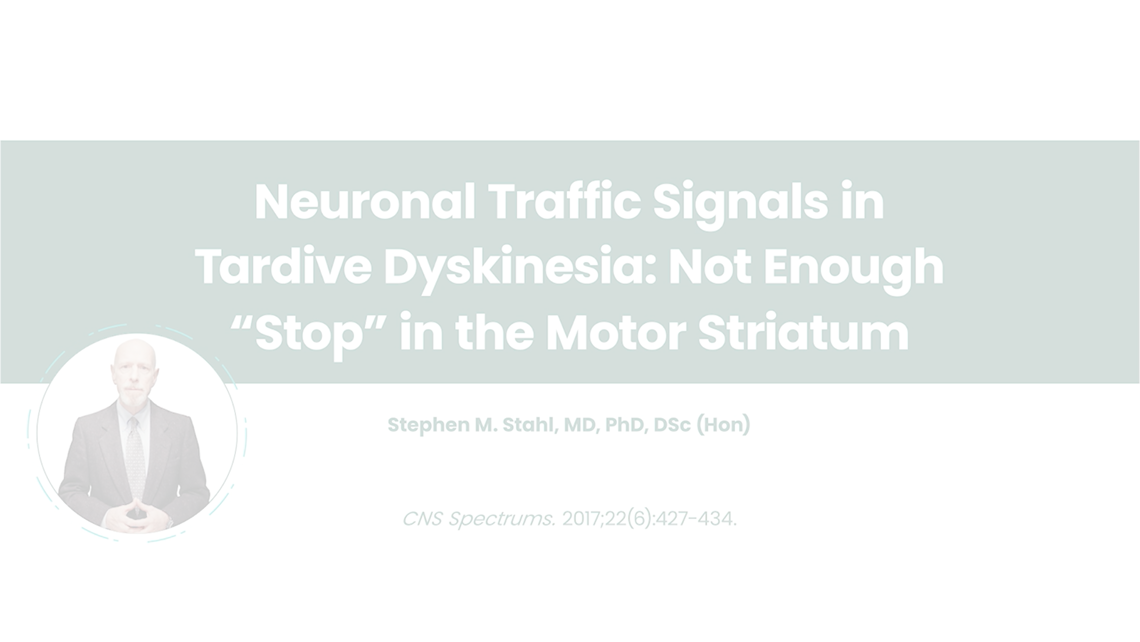
Neuronal Traffic Signals in Tardive Dyskinesia: Not Enough “Stop” in the Motor Striatum

  • Leslie Citrome, MD, MPH

Video

•

~7 mins

•

Jan 2025

Copy Link Share via Email Share via SMS

Dr Leslie Citrome presents a journal article written by Dr Stephen Stahl that reviews the proposed neurobiology of TD.

Neuronal Traffic Signals in Tardive Dyskinesia: Not Enough "Stop" in the Motor Striatum, Video

Related Resources


  • Article

    •

    ~5 mins

    •

    Sep 2022


    Tardive Dyskinesia vs Drug-Induced Parkinsonism: Know the Difference to Make a Difference

  • Podcast

    •

    10+ mins

    •

    Oct 2021


    Tardive Dyskinesia: Understanding How and Why It Happens—A Conversation Between Psychiatry and Neurology
  • Presentation

    •

    10+ mins

    •

    Dec 2024


    Tardive Dyskinesia Differential Diagnosis Slide Library
Neurocrine Biosciences Logo

©2026 Neurocrine Biosciences, Inc. All Rights Reserved.

  • Privacy Policy
  • Cookie Policy
  • Terms & Conditions
  • Accessibility
  • Site Map
CP-TD-US-1751v4   02/2026

The MIND-TD website and educational content were sponsored and co-developed by Neurocrine Biosciences, Inc. The faculty have been compensated by Neurocrine Biosciences. This non-CME program is intended to provide general information about tardive dyskinesia and not medical advice for any particular patient.

You are about to leave this website

Leave Site

By continuing to use this site, you agree to our use of cookies as described in our Cookie Policy.

This site contains information intended only for US healthcare professionals involved in the management of people with tardive dyskinesia.

This website is part of a disease-awareness, non-CME program sponsored by Neurocrine Biosciences, Inc.